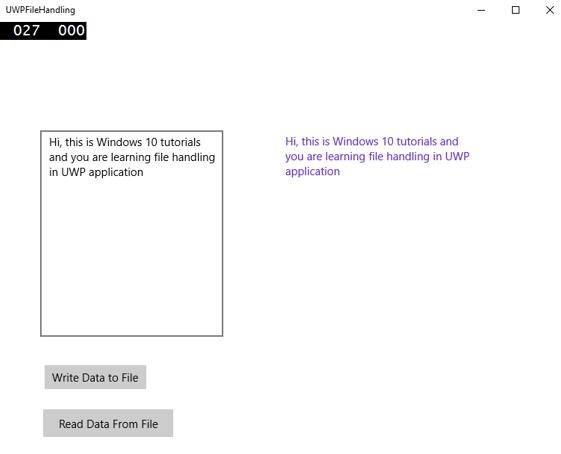
Windows10 开发 – 文件管理
Windows10 开发 – 文件管理
在任何应用程序中,最重要的事情之一就是数据。如果您是.net开发人员,您可能了解隔离存储,并且通用 Windows 平台 (UWP) 应用程序遵循相同的概念。
文件位置
这些是您的应用程序可以访问数据的区域。该应用程序包含一些区域,该区域是该特定应用程序的私有区域,其他区域无法访问,但还有许多其他区域,您可以在其中存储和保存文件中的数据。
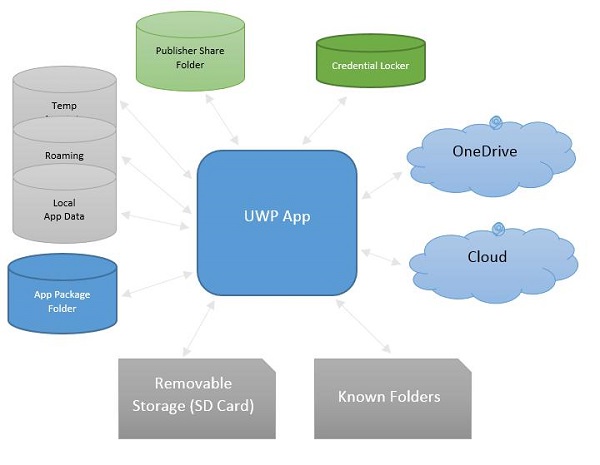
下面给出了每个文件夹的简要说明。
| S.No. | 文件夹和说明 |
|---|---|
| 1 |
App package folder 包管理器将应用程序的所有相关文件安装到应用程序包文件夹中,应用程序只能从该文件夹中读取数据。 |
| 2 |
Local folder 应用程序将本地数据存储到本地文件夹中。它可以将数据存储到存储设备上的限制。 |
| 3 |
Roaming folder 与应用程序相关的设置和属性存储在漫游文件夹中。其他设备也可以访问此文件夹中的数据。每个应用程序的大小限制为 100KB。 |
| 4 |
Temp Folder 使用临时存储并不能保证在您的应用程序再次运行时它仍然可用。 |
| 5 |
Publisher Share 来自同一发布者的所有应用程序的共享存储。它在应用程序清单中声明。 |
| 6 |
Credential Locker 用于密码凭证对象的安全存储。 |
| 7 |
OneDrive OneDrive 是 Microsoft 帐户附带的免费在线存储。 |
| 8 |
Cloud 将数据存储在云端。 |
| 9 |
Known folders 这些文件夹是已知的文件夹,例如 My Pictures、Videos 和 Music。 |
| 10 |
Removable storage USB 存储设备或外部硬盘驱动器等。 |
文件处理 API
在 Windows 8 中,引入了用于文件处理的新 API。这些 API 位于Windows.Storage和Windows.Storage.Streams命名空间中。您可以使用这些 API 代替System.IO.IsolatedStorage命名空间。通过使用这些 API,可以更轻松地将您的 Windows Phone 应用程序移植到 Windows 应用商店,并且您可以轻松地将您的应用程序升级到 Windows 的未来版本。
要访问本地、漫游或临时文件夹,您需要调用这些 API –
StorageFolder localFolder = ApplicationData.Current.LocalFolder;
StorageFolder roamingFolder = ApplicationData.Current.RoamingFolder;
StorageFolder tempFolder = ApplicationData.Current.TemporaryFolder;
要在本地文件夹中创建一个新文件,请使用以下代码 –
StorageFolder localFolder = ApplicationData.Current.LocalFolder;
StorageFile textFile = await localFolder.CreateFileAsync(filename,
   CreationCollisionOption.ReplaceExisting);
这是打开新创建的文件并在该文件中写入一些内容的代码。
using (IRandomAccessStream textStream = await textFile.OpenAsync(FileAccessMode.ReadWrite)) {

   using (DataWriter textWriter = new DataWriter(textStream)){
      textWriter.WriteString(contents);
      await textWriter.StoreAsync();
   }

}
您可以从本地文件夹再次打开同一个文件,如下面的代码所示。
using (IRandomAccessStream textStream = await textFile.OpenReadAsync()) {

   using (DataReader textReader = new DataReader(textStream)){
      uint textLength = (uint)textStream.Size;
      await textReader.LoadAsync(textLength);
      contents = textReader.ReadString(textLength);
   }

}
为了理解数据的读写是如何工作的,让我们看一个简单的例子。下面给出了 XAML 代码,其中添加了不同的控件。
<Page
   x:Class = "UWPFileHandling.MainPage"
   xmlns = "http://schemas.microsoft.com/winfx/2006/xaml/presentation"
   xmlns:x = "http://schemas.microsoft.com/winfx/2006/xaml"
   xmlns:local = "using:UWPFileHandling"
   xmlns:d = "http://schemas.microsoft.com/expression/blend/2008"
   xmlns:mc = "http://schemas.openxmlformats.org/markup-compatibility/2006"
   mc:Ignorable = "d">

   <Grid Background = "{ThemeResource ApplicationPageBackgroundThemeBrush}">

      <Button x:Name = "readFile" Content = "Read Data From File"
         HorizontalAlignment = "Left" Margin = "62,518,0,0"
         VerticalAlignment = "Top" Height = "37" Width = "174"
         Click = "readFile_Click"/>

      <TextBox x:FieldModifier = "public" x:Name = "textBox"
         HorizontalAlignment = "Left" Margin = "58,145,0,0" TextWrapping = "Wrap"
         VerticalAlignment = "Top" Height = "276" Width = "245"/>.

      <Button x:Name = "writeFile" Content = "Write Data to File"
         HorizontalAlignment = "Left" Margin = "64,459,0,0"
         VerticalAlignment = "Top" Click = "writeFile_Click"/>

      <TextBlock x:Name = "textBlock" HorizontalAlignment = "Left"
         Margin = "386,149,0,0" TextWrapping = "Wrap"
         VerticalAlignment = "Top" Height = "266" Width = "250"
         Foreground = "#FF6231CD"/>

   </Grid>

</Page>
下面给出了不同事件的 C# 实现以及用于读取和写入数据到文本文件的FileHelper类的实现。
using System;
using System.IO;
using System.Threading.Tasks;

using Windows.Storage;
using Windows.Storage.Streams;
using Windows.UI.Xaml;
using Windows.UI.Xaml.Controls;

// The Blank Page item template is documented at
   http://go.microsoft.com/fwlink/?LinkId=402352&clcid=0x409

namespace UWPFileHandling {

   /// <summary>
      /// An empty page that can be used on its own or navigated to within a Frame.
   /// </summary>

   public partial class MainPage : Page {
      const string TEXT_FILE_NAME = "SampleTextFile.txt";

      public MainPage(){
         this.InitializeComponent();
      }

      private async void readFile_Click(object sender, RoutedEventArgs e) {
         string str = await FileHelper.ReadTextFile(TEXT_FILE_NAME);
         textBlock.Text = str;
      }

      private async void writeFile_Click(object sender, RoutedEventArgs e) {
         string textFilePath = await FileHelper.WriteTextFile(TEXT_FILE_NAME, textBox.Text);
      }

   }

   public static class FileHelper {

      // Write a text file to the app's local folder.

      public static async Task<string>
         WriteTextFile(string filename, string contents) {

         StorageFolder localFolder = ApplicationData.Current.LocalFolder;
         StorageFile textFile = await localFolder.CreateFileAsync(filename,
            CreationCollisionOption.ReplaceExisting);

         using (IRandomAccessStream textStream = await
            textFile.OpenAsync(FileAccessMode.ReadWrite)){

               using (DataWriter textWriter = new DataWriter(textStream)){
                  textWriter.WriteString(contents);
                  await textWriter.StoreAsync();
               }
         }

         return textFile.Path;
      }

      // Read the contents of a text file from the app's local folder.

      public static async Task<string> ReadTextFile(string filename) {
         string contents;
         StorageFolder localFolder = ApplicationData.Current.LocalFolder;
         StorageFile textFile = await localFolder.GetFileAsync(filename);

         using (IRandomAccessStream textStream = await textFile.OpenReadAsync()){

            using (DataReader textReader = new DataReader(textStream)){
               uint textLength = (uint)textStream.Size;
               await textReader.LoadAsync(textLength);
               contents = textReader.ReadString(textLength);
            }

         }

         return contents;
      }
   }
}
上述代码编译执行后,会看到如下窗口。
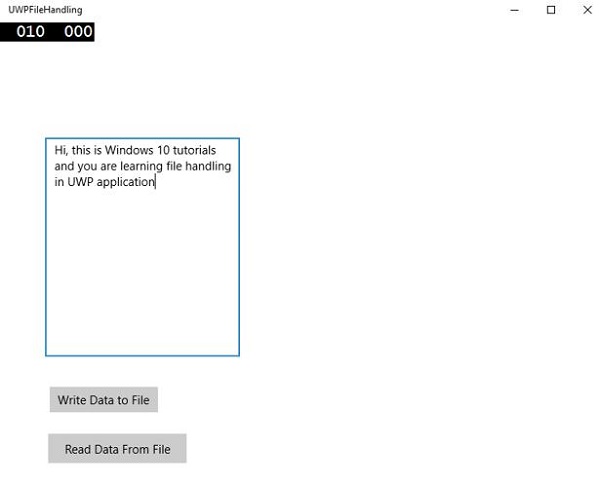
现在,您在文本框中写入一些内容,然后单击“将数据写入文件”按钮。程序会将数据写入本地文件夹中的文本文件。如果单击“从文件中读取数据”按钮,程序将从位于本地文件夹中的同一文本文件中读取数据并将其显示在文本块上。