Concordion – verifyRows 命令
Concordion – verifyRows 命令
Concordion verifyRows 命令可用于检查系统作为结果返回的集合的内容。例如,如果我们在系统中设置一组用户并对其进行部分搜索,那么系统应该返回匹配的元素,否则我们的验收测试将失败。
考虑以下要求 –
<table>
   <tr><th>Users</th></tr>
   <tr><td>Robert De</td></tr>
   <tr><td>John Diere</td></tr>
   <tr><td>Julie Re</td></tr>
</table>

<p>Search for J should return:</p>

<table>
   <tr><th>Matching Users</th></tr>
   <tr><td>John Diere</td></tr>
   <tr><td>Julie Re</td></tr>
</table>
如果我们想为这样的搜索函数编写一个规范来搜索并返回一个集合,那么规范将如下 –
<table concordion:execute = "addUser(#username)">
   <tr><th concordion:set = "#username">Username</th></tr>
   <tr><td>Robert De</td></tr>
   <tr><td>John Diere</td></tr>
   <tr><td>Julie Re</td></tr>
</table>

<p>Search for "<b concordion:set = "#searchString">J</b>" should return:</p>

<table concordion:verifyRows = "#username : search(#searchString)">
   <tr><th concordion:assertEquals = "#username">Matching Usernames</th></tr>
   <tr><td>John Diere</td></tr>
   <tr><td>Julie Re</td></tr>
</table>
当 Concordion 解析文档时,它将在第一个表的每一行上执行 addUser(),然后将 searchString 设置为 J。接下来,Concordion 将执行搜索函数,该函数应该返回一个具有可预测迭代顺序的 Iterable 对象,(例如List、LinkedHashSet 或 TreeSet),verifyRows 为集合的每个项目运行并运行 assertEquals 命令。
例子
让我们有一个可用的 Eclipse IDE,并按照下面给出的步骤创建一个 Concordion 应用程序 –
| Step | 描述 |
|---|---|
| 1 | 创建一个名为concordion的项目,并在创建的项目的src文件夹下创建一个包com.tutorialspoint。 |
| 2 | 使用添加外部 JAR选项添加所需的 Concordion 库,如Concordion – First Application章节中所述。 |
| 3 | 在com.tutorialspoint包下创建 Java 类System。 |
| 4 | 创建夹具类SystemFixture下specs.tutorialspoint包。 |
| 5 | 建立规范的HTML System.html下specs.tutorialspoint包。 |
| 6 | 最后一步是创建所有 Java 文件和规范文件的内容并运行应用程序,如下所述。 |
这是 System.java 文件的内容 –
package com.tutorialspoint;

import java.util.HashSet;
import java.util.Set;
import java.util.SortedSet;
import java.util.TreeSet;

public class System {
   private Set<String> users = new HashSet<String>();

   public void addUser(String username) {
      users.add(username);
   }

   public Iterable<String> search(String searchString) {
      SortedSet<String> matches = new TreeSet<String>();

      for (String username : users) {
         if (username.contains(searchString)) {
            matches.add(username);
         }
      }

      return matches;
   }
}
以下是 SystemFixture.java 文件的内容 –
package specs.tutorialspoint;

import org.concordion.integration.junit4.ConcordionRunner;
import org.junit.runner.RunWith;
import com.tutorialspoint.System;

@RunWith(ConcordionRunner.class)

public class SystemFixture {
   System system = new System();
   public void addUser(String username) {
      system.addUser(username);
   }

   public Iterable<String> search(String searchString) {
      return system.search(searchString);
   }
}
以下是 System.html 文件的内容 –
<html xmlns:concordion = "http://www.concordion.org/2007/concordion">
   <head>
      <link href = "../concordion.css" rel = "stylesheet" type = "text/css" />
   </head>

   <body>
      <h1>System Specifications</h1>
      <p>We are building specifications for our online order tracking application.</p>
      <p>Following is the requirement to add a partial search capability on user names:</p>

      <div class = "example">
         <h3>Example</h3>

         <table concordion:execute = "addUser(#username)">
            <tr><th concordion:set = "#username">Username</th></tr>
            <tr><td>Robert De</td></tr>
            <tr><td>John Diere</td></tr>
            <tr><td>Julie Re</td></tr>
         </table>

         <p>Search for "<b concordion:set = "#searchString">J</b>" should return:</p>

         <table concordion:verifyRows = "#username : search(#searchString)">
            <tr><th concordion:assertEquals = "#username">Matching Usernames</th></tr>
            <tr><td>John Diere</td></tr>
            <tr><td>Julie Re</td></tr>
         </table>

      </div>

   </body>

</html>
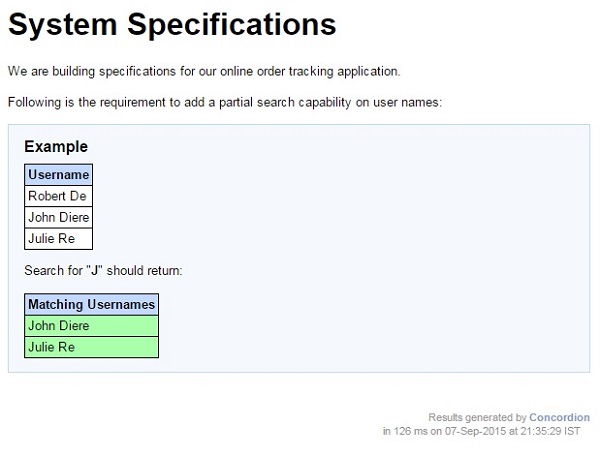
完成源文件和规范文件的创建后,让我们将应用程序作为 JUnit 测试运行。如果您的应用程序一切正常,那么它将产生以下结果 –
C:\DOCUME~1\ADMINI~1\LOCALS~1\Temp\concordion\specs\tutorialspoint\System.html
Successes: 2, Failures: 0
System.html 是 Concordion 测试运行的输出。