Watir – 页面对象
Watir – 页面对象
Watir 中的页面对象帮助我们以类的形式重用代码。使用页面对象功能,我们可以自动化我们的应用程序,而无需复制任何代码,并使代码易于管理。
测试时,我们可以为要测试的每个页面创建页面对象。然后,我们将使用页面对象访问方法和属性。
使用页面对象背后的原因 –
-
如果在更改更改时对页面进行了任何更改,则不需要重新编写代码。
-
避免代码冗余。
我们将使用 RSpec 在 Watir 中使用页面对象。如果您不熟悉 RSpec,这里有一个完整的RSpec教程供您学习。
我们要执行测试的页面在这里给出 –
文本框.html
<html>
   <head>
      <title>Testing UI using Watir</title>
   </head>

   <body>
      <script type = "text/javascript">
         function wsentered() {
            console.log("inside wsentered");
            var firstname = document.getElementById("firstname");

            if (firstname.value != "") {
               document.getElementById("displayfirstname").innerHTML =
                  "The name entered is : " + firstname.value;

               document.getElementById("displayfirstname").style.display = "";
            }
         }
      </script>

      <div id = "divfirstname">
         Enter First Name :
         <input type = "text" id = "firstname" name = "firstname" onchange = "wsentered()" />
      </div>
      <br/>
      <br/>
      <div style = "display:none;" id = "displayfirstname"></div>
   </body>
</html>
输出
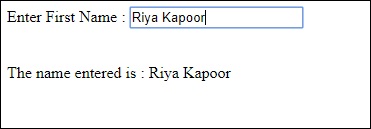
我们现在将为上述页面创建页面对象,如下所示 –
页面对象测试.rb
class InitializeBrowser
   def initialize(browser)
      @browser = browser
   end
end

class TestPage lt; InitializeBrowser
   def textbox
      @textbox = TestTextbox.new(@browser)
   end
   def close
      @browser.screenshot.save 'usingpageobject.png'
      @browser.close
   end
end # TestPage

class TestTextbox < InitializeBrowser
   URL = "http://localhost/uitesting/textbox.html"

   def open
      @browser.goto URL
      self
   end
   def enterdata_as(name)
      name_field.set name
      name_field.fire_event('onchange')
   end

private
   def name_field
      @browser.text_field(:id > "firstname")
   end
end # TestTextbox
定义了三个类 – InitializeBrowser、TestPage 和 TestTextbox –
-
InitializeBrowser – 这将初始化打开的浏览器并与 TestPage 和 TestTextbox 类共享浏览器对象。
-
TestPage – 此类将具有对 TestTextbox 的对象引用,并包含捕获屏幕截图和关闭浏览器的方法。
-
TestTextbox – 此类将具有打开页面 url、引用文本字段、设置数据和触发 onchange 事件的方法。
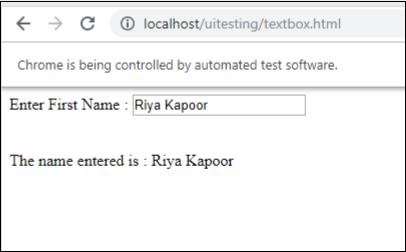
执行上面显示的代码后,您可以看到如下所示的输出 –